Market Efficiency Ratio [Interakktive]
A diagnostic tool that decomposes price movement into directional progress versus wasted oscillatory movement. Quantifies what proportion of total travel distance represented genuine advancement versus sideways chop.
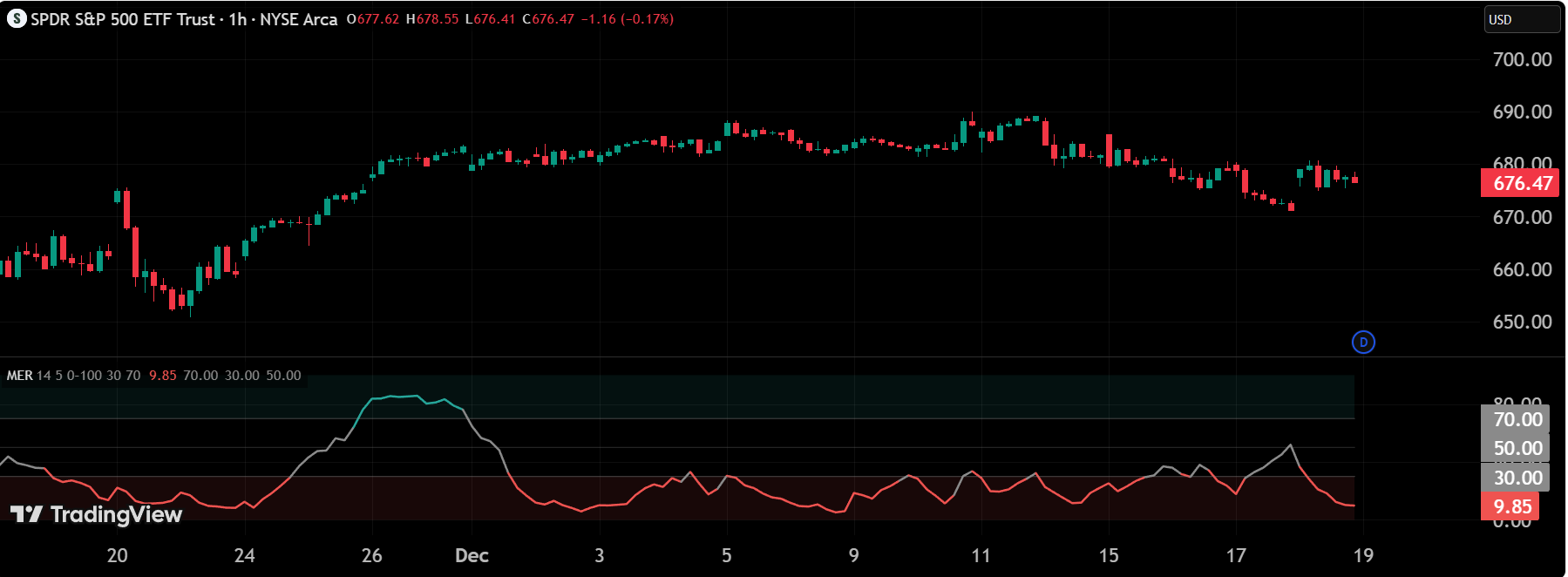
Key Features
- ✓Efficiency Ratio calculation (0-100 scale)
- ✓Net Displacement measurement
- ✓Path Length tracking (total distance traveled)
- ✓Chop Cost quantification
- ✓Visual efficiency zones (Green/Yellow/Red)
- ✓Customizable lookback and smoothing parameters
Use Cases
- →Differentiate clean trending periods from messy consolidation
- →Understand relationship between total movement and productive progress
- →Identify high-chop environments presenting elevated trading difficulty
- →Assess trend quality without volume dependence
- →Foundation work for advanced regime detection systems
Technical Details
Net Displacement = |Close[current] - Close[N bars back]|; Path Length = Sum of bar-to-bar absolute changes; Efficiency Ratio = Net Displacement / Path Length. Default: 14-bar lookback, 5-bar EMA smoothing.
Ready to try it?
Add this indicator to your TradingView charts for free. No signup required.
Open on TradingViewExplore More Indicators
Market Adaptive Trend
A diagnostic trend baseline that re-tunes its own responsiveness to the live volatility regime — and narrates why, in plain English. Reveals how the trend is behaving, not where price "should" go.
Learn more →Sessions +
A standalone session intelligence indicator with DNA predictor narrative, adaptive multi-timeframe level degradation, and session-based structure analysis. Built as the gateway to the ATLAS suite — full diagnostic transparency with zero cost.
Learn more →